
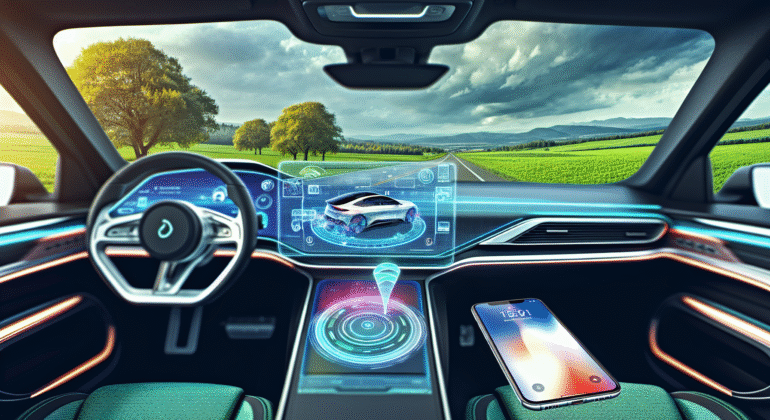
In 2025, the line between car and computer will be blurrier than ever. Automotive technology is accelerating at warp speed, promising a driving experience that’s safer, more connected, and undeniably smarter. Forget basic Bluetooth connectivity; we’re talking about gadgets that anticipate your needs, react to your surroundings, and fundamentally change how you interact with your vehicle. Here are seven smart car gadgets that you won’t want to be without in 2025:
1. Predictive Driver-Assistance Systems (PDAS): Forget adaptive cruise control; PDAS takes driver-assistance to a whole new level. These systems go beyond reacting to immediate surroundings. They leverage AI and machine learning, analyzing historical traffic data, weather patterns, and even your personal driving habits to anticipate potential hazards before they even appear. Imagine your car subtly adjusting its speed and trajectory *before* you even see the traffic slowing down ahead, significantly reducing the risk of accidents. PDAS will use external sensors vastly improved over today’s tech, including enhanced lidar with greater range and resolution, as well as AI-powered image recognition that can identify pedestrians, cyclists, and even animals far beyond the range of human vision.
2. Augmented Reality Heads-Up Displays (AR-HUD): Heads-up displays are already a thing, but in 2025, prepare for a fully immersive AR experience. Imagine navigation directions seamlessly overlaid onto the real world, highlighting the precise lane you need to be in, or pointing out points of interest with virtual markers. More than just navigation, an AR-HUD can highlight potential hazards, such as pedestrians crossing the street at night, by illuminating them with a virtual spotlight. Information is delivered precisely where you need it, eliminating distractions and keeping your eyes firmly on the road. Furthermore, the personalized information displayed will be customisable based on user preference, with the aim of reducing the stress and cognitive load of driving.
3. Biometric Vehicle Access and Personalization: Keys are becoming relics of the past. In 2025, your car will recognize you. Facial recognition, fingerprint scanning, and even voice authentication will become commonplace for vehicle access. But it doesn’t stop there. Once identified, the car will automatically adjust seat settings, mirror positions, climate control, and even infotainment preferences to your personalized profile. Imagine seamless transitions between drivers, with each person’s preferences instantly loaded upon entry. Biometric data might also be used for health monitoring, alerting you to potential fatigue or stress based on subtle changes in your heart rate or facial expressions.
4. Smart Tire Monitoring Systems (STMS) with Predictive Maintenance: Forget simply monitoring tire pressure; STMS in 2025 will offer a complete picture of tire health. Embedded sensors will track tread depth, temperature, and even subtle changes in tire composition. This data will be analyzed by sophisticated algorithms to predict when your tires need to be replaced, preventing blowouts and optimizing fuel efficiency. The system might even suggest optimal tire pressures based on your driving style and road conditions, maximizing performance and safety. Furthermore, imagine a system that detects a slow leak and automatically contacts a nearby service center to schedule a repair, all before you even notice a problem.
5. Advanced Noise Cancellation Systems: Road noise can be a major source of driver fatigue. In 2025, expect advanced noise cancellation systems to create a tranquil and focused driving environment. These systems will use a network of microphones both inside and outside the car to identify and neutralize unwanted sounds, like road noise, wind buffeting, and even engine vibrations. The systems will be so sophisticated that they can target specific frequencies of noise, while still allowing you to hear important sounds like sirens or horns. Imagine enjoying crystal-clear audio for your music and phone calls, even on the roughest roads.
6. AI-Powered Voice Assistants with Contextual Awareness: Say goodbye to clunky voice commands. In 2025, voice assistants will be seamlessly integrated into your driving experience. These assistants will be contextually aware, understanding your intentions based on your location, time of day, and even your recent activities. Instead of just saying “Navigate to the nearest gas station,” you could say “I’m getting low on gas,” and the car will intelligently find the closest and cheapest option, factoring in your preferred gas brand. These AI assistants will also learn your preferences over time, becoming truly personalized and intuitive companions. This might include proactive suggestions based on driving parameters and common routes.
7. Vehicle-to-Everything (V2X) Communication Systems: The future of driving is connected. V2X technology allows your car to communicate with other vehicles, infrastructure, and even pedestrians’ devices. This opens a world of possibilities, from receiving real-time warnings about traffic congestion and road hazards to automatically adjusting your speed to avoid collisions. Imagine approaching a blind intersection and receiving a warning about an approaching vehicle hidden from view, or getting an immediate alert about a pedestrian crossing the street ahead. V2X technology promises to dramatically improve safety and efficiency on the roads, ushering in a new era of cooperative driving. While the widespread adoption of V2X depends on regulatory frameworks and infrastructure development, by 2025, expect to see significant advancements in this technology, laying the foundation for a truly connected automotive ecosystem.
Conclusions
Smart car gadgets are rapidly redefining automotive safety, comfort, and sustainability for 2025. From advanced driver assistance systems to eco-friendly innovations, these technologies are not just nice-to-have accessories—they’re essential for safer, smoother, and smarter journeys ahead. Investing in these gadgets today means a more connected and responsible driving experience for tomorrow.